Hidden Operational Waste: 5 Processes Costing Your Business More Than You Think
Hidden inefficiencies drain business growth; strategic automation fixes them.
Read postLong gone are the days when an automation specialist simply wired one app to another and called it a day. Today automation specialists in remote teams design, build, and maintain the systems that run critical operations end-to-end. They solve messy real-world problems (data quality, error handling, compliance, scaling) and more.
This article explains what an automation specialist does day-to-day, how that differs from an automation engineer or a workflow operator.
An automation specialist (also called a business automation specialist or operational automation expert) is a cross-disciplinary practitioner who maps business processes, designs automation architecture, implements automation tools and AI where appropriate, and operates those systems in production.
Unlike a tool operator who assembles point-to-point workflows, the automation specialist thinks in systems, data flows, error modes, monitoring, governance, and business outcomes.
Then comes the next question;
Automation Specialists act as the bridge between human and machine. Real automation roles and responsibilities typically include:
An automation specialist focuses on business workflows, designing automation around real operations, data flows, and outcomes, and bridging operations, product, and IT teams. An automation engineer is more engineering-focused, building the technical infrastructure, code, and systems that automation runs on. While their emphasis differs, both roles require strong technical expertise.
“Workflow automation” commonly means automating individual sequences of tasks (e.g., form to approval to notification). Though this works, its limited.
Business automation covers the broader ecosystem including data ingestion, validation, cross-system orchestration, human-in-the-loop decision points, model inferences, observability, and recovery. Gartner’s hyperautomation concept recognizes that modern automation is business-driven and disciplined, aimed at automating many business and IT processes holistically rather than only individual workflows.
Have you come across a recruitment system that ingest resumes, score candidates using machine learning or LLMs? This is a real-world example of how automation specialists automate an entire phase of a hiring workflow. Generally these systems do more than sorting CVs. They automate interview scheduling, collect interviewer feedback, and maintain compliance logs. These systems reduce hiring time while keeping decisions traceable and auditable.
Deloitte research shows organizations are increasingly focused on skill partnerships, people working with intelligent automation rather than being replaced by it. That’s why skills of an automation specialist are no longer negotiable.
A recent Mckinsey survey identified the rapidly growing adoption of automation across major global markets.
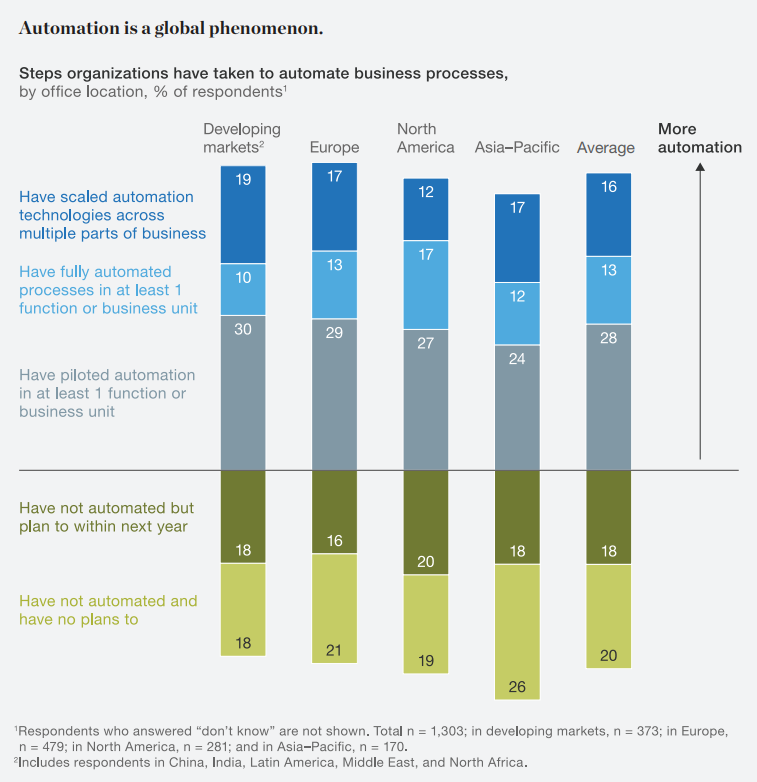
Source: McKinsey
Businesses hire automation specialists because systems-led automation delivers real, scalable ROI. By reducing manual work and errors, automation lowers costs, speeds up operations, and improves customer experience.
If your team measures automation by a growing list of one-off integrations, you’ll hit brittle scaling limits. Automation specialists bring the systems perspective, designing resilient, observable, and governed automation that lets businesses scale without chaos. For AI-first companies like ApexAI, the difference between “ workflows that sometimes work” and “automations that run the business” is worth hiring for.
Hidden inefficiencies drain business growth; strategic automation fixes them.
Read post
Prioritize AI strategy over tool adoption to avoid fragmented, expensive systems and chaotic workflows. Proper architectural planning reduce
Read post
Explore real-world automation use cases Apex AI delivers to scale marketing and finance operations with reliable, system-level automation.
Read postFind out exactly where AI can transform your business, with experts starting from A$80 per hour.
Book a free discovery call